
Diljit Dosanjh releases ‘Sanson Ki Mala Pe’ from Wembley: Here’s the Timeless song’s journey across generations
Sanson Ki Mala Pe has travelled across generations, from Nusrat Fateh Ali Khan’s iconic qawwali to Diljit Dosanjh’s Wembley rendition and Mirzapur: The Movie. Here's the history, popular renditions and timeless emotion behind the classic.


Diljit Dosanjh releases ‘Sanson Ki Mala Pe’ from Wembley: Here’s the Timeless song’s journey across generations
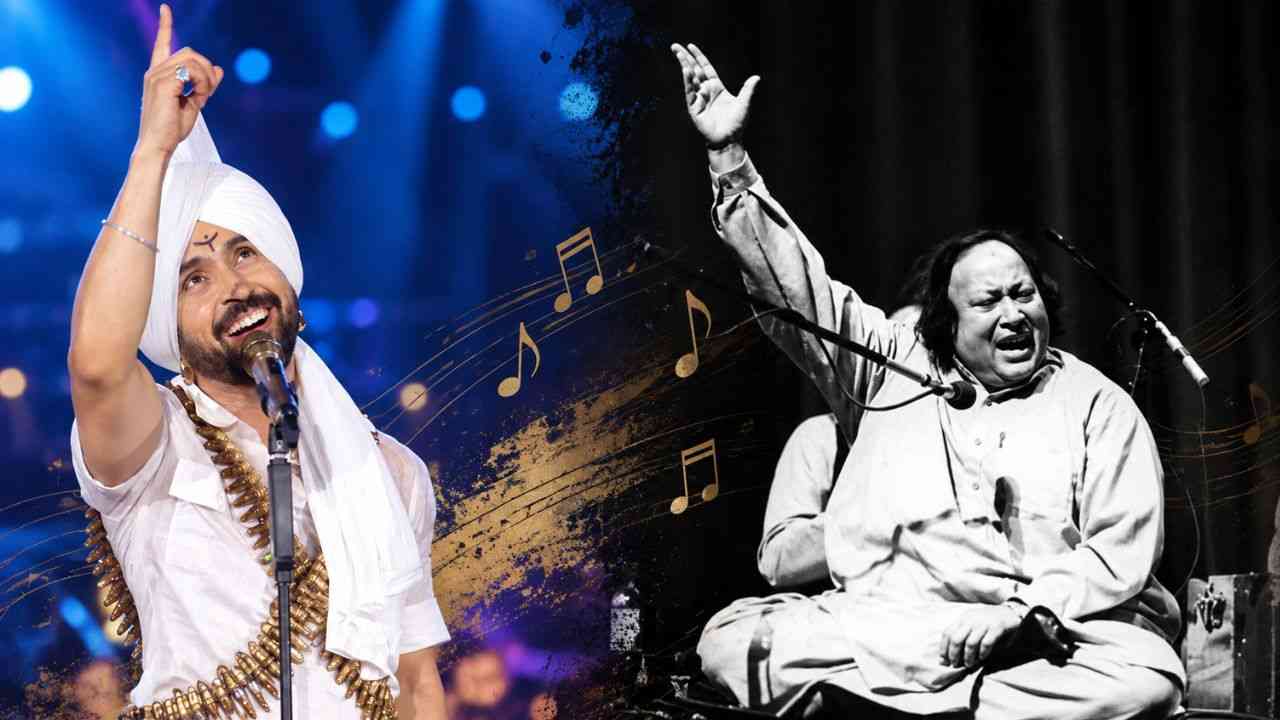
When Diljit Dosanjh took the stage at Wembley Stadium during his Aura World Tour 2026, he did more than perform a classic. He brought back a piece of musical nostalgia that has travelled across generations. During his historic September 12 performance, Diljit became the first Punjabi artist to headline Wembley, a stadium with a capacity of around 90,000. And when he performed “Sanson Ki Mala Pe”, the atmosphere turned deeply emotional, with the audience joining him in a moment that felt like a tribute to a song that has lived many musical lives.
Sanson Ki Mala: The Timeless Classic of All Times
Diljit’s rendition is only the latest chapter in the long journey of “Sanson Ki Mala Pe”. From Ustad Nusrat Fateh Ali Khan to Madhur Sharma, Rahat Fateh Ali Khan and several film adaptations, the song has repeatedly been given a new sound while keeping its soul intact.
Diljit Dosanjh Releases Sanson Ki Mala Pe
Diljit Dosanjh gave “Sanson Ki Mala Pe” a beautiful new moment during his historic Wembley Stadium concert in September 2026. Known for his energetic performances, Diljit took a softer and more soulful route with this timeless classic, paying tribute to the legendary Ustad Nusrat Fateh Ali Khan. As the music played and thousands of fans held their phone lights up in the air, the stadium turned into a sea of lights and emotions. His rendition felt less like a regular concert performance and more like a heartfelt tribute to a song that has been loved for generations. It was a moment filled with nostalgia, respect and pure emotion proving once again that some songs can bring an entire audience together, no matter how many years have passed.
Mirzapur: The Movie Gives It a New Life
The song is currently enjoying another major revival through Mirzapur: The Movie. The 2026 soundtrack features Madhur Sharma on vocals, with Vaibhav Pani handling the music production and a musical foundation connected to Nusrat Fateh Ali Khan’s composition and vocals.
Its appearance in the film adds an interesting emotional layer. The song is used around a pivotal sequence involving Beena Tripathi, played by Rasika Dugal, where devotion, silence and betrayal come together in an unusual contrast. Dugal has spoken about how the song expresses emotions that her character cannot say aloud.
From Khan Saab to Diljit
For many listeners, however, the name most closely associated with “Sanson Ki Mala Pe” remains Ustad Nusrat Fateh Ali Khan. The qawwali became part of his musical legacy and was reportedly performed by him during his first visit to India in 1979. His Birmingham performance in 1983 is among the celebrated versions associated with the song’s journey.
Ustaad Nusrat Fateh Ali Khan
Nusrat’s version had the freedom of a traditional qawwali performance allowing the melody to breathe, expand and build through improvisation. Recordings of the song have appeared in different lengths, including an 18-minute-plus version, showing just how much space the composition could occupy in a live musical setting.
The Song’s Bollywood Journey
“Sanson Ki Mala” has also had a fascinating journey through Hindi cinema. It was recreated for Jeet (1996) with music by Nadeem-Shravan and subsequently appeared in Koyla (1997), where Rajesh Roshan recomposed the song and Kavita Krishnamurthy lent her voice.
The original Nusrat version later found its way into Michael Winterbottom’s Trishna (2011). The song was also reimagined as “Simroon Tera Naam” for Yaariyan 2 in 2023, giving the familiar emotional idea another contemporary film treatment.
Rahat Fateh Ali Khan and Other Modern Versions
The legacy naturally reached Rahat Fateh Ali Khan, Nusrat’s nephew and disciple. In 2020, Rahat released his own version as a tribute to Nusrat and his father, Ustad Farrukh Fateh Ali Khan.
The song has also travelled far beyond traditional qawwali. Modern musicians and creators have experimented with acoustic, fusion and even heavy-metal interpretations, including a viral guitar version by Andre Antunes built around Nusrat’s original vocals.
But Where Did “Sanson Ki Mala Pe” Come From?
At its heart, “Sanson Ki Mala” is about complete surrender to love and the divine. The central thought remembering the beloved with every breath turns breathing itself into an act of devotion. That is what makes the song so powerful: it can sound like a prayer, a love song or a spiritual confession, depending on how you hear it.
The song is also surrounded by an interesting history of authorship. It has long been popularly associated with the medieval Bhakti saint Mirabai, because of its Krishna-devotional imagery. However, literary records also connect the modern ghazal text beginning “Sanson ki mala par simrun nis-din pi ka naam” with Pakistani poet and lyricist Tufail Hoshiarpuri, whose work appeared in his 1995 poetry collection Soch Mala. Earlier commercial releases of Nusrat’s recording had credited the lyrics as “Traditional,” which added to the confusion around its origins. The lyrics are widely associated with Mirabai, the medieval Bhakti poet and Krishna devotee, because of their strong themes of devotion and longing. However, literary records also credit Tufail Hoshiarpuri with the modern ghazal version, creating an attribution history that is more complicated than popular culture often suggests.
At its heart, the line “Sanson ki mala pe, simroon main pi ka naam” expresses a simple but powerful thought: with every breath, remember the name of the beloved. That beloved can be understood through romantic love, spiritual devotion or complete surrender to the divine.
And perhaps that is why the song refuses to grow old.
From Nusrat Sahib’s powerful qawwali gatherings to Bollywood, from Rahat Fateh Ali Khan and Madhur Sharma to Diljit Dosanjh’s Wembley stage, “Sanson Ki Mala Pe” keeps changing its voice without losing its heartbeat.
Different artists, different eras, different arrangements but when those first notes play, the feeling is still the same. A little nostalgia. A little devotion. And, somehow, goosebumps.
- PTC PUNJABI



Popular Posts
-

Rakhi Sawant breaks down into tears during her song launch 'Jhootha'; Watch Video
-

Oscars 2023; When, Where and How? Everything you need to know about this years Academy Awards
-

Diljit Dosanjh praises Parineeti Chopra; says 'film ch kamaal kam kita'
-

Harinder Singh Sidhu: A dose of entertainment with YouTuber-actor-producer Dxx
-

'Kali Jotta': Neeru Bajwa, Satinder Sartaaj's film ticket prices reduces; available at Rs 112