
80s AI photo trend goes viral: Is there a hidden Environmental cost?
The 80s AI photo trend is taking over Instagram, with celebrities and fans embracing retro makeovers. Here's why it is viral and its privacy and environmental concerns.


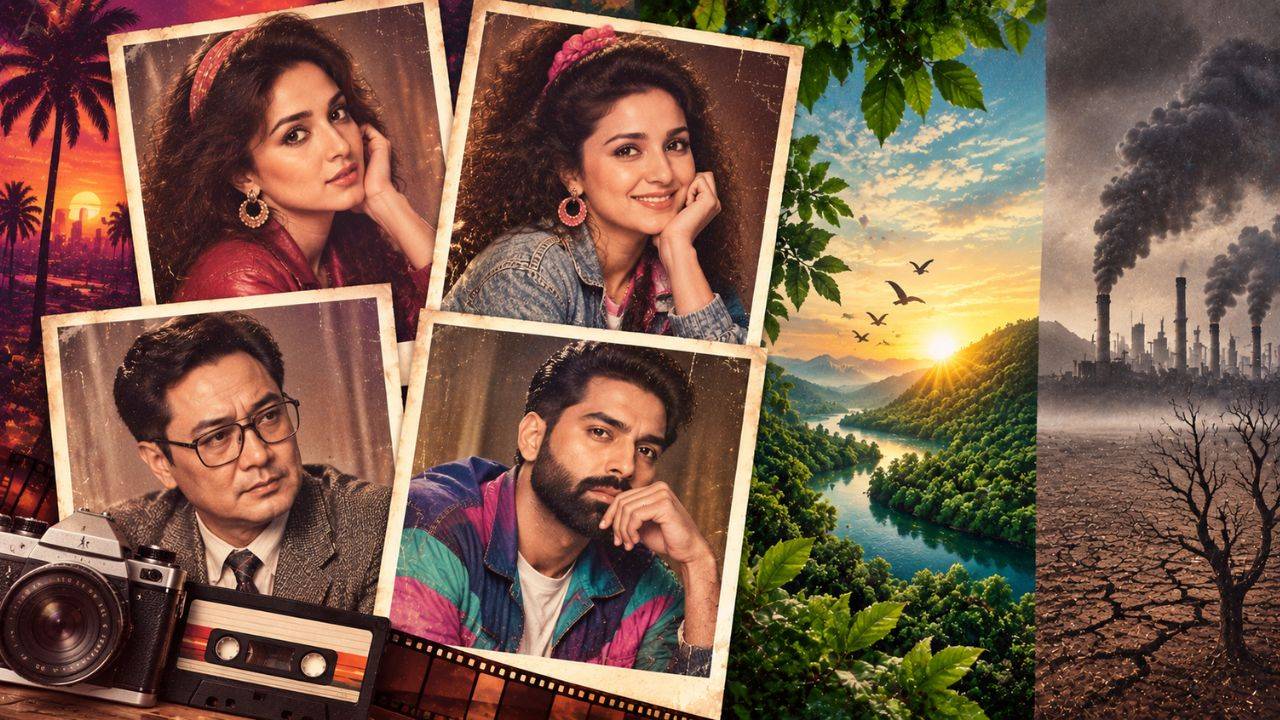
80s AI photo trend goes viral: Is there a hidden Environmental cost?
Social media has a new obsession every few weeks, and this time, it is taking everyone several decades back. After the internet went crazy over Studio Ghibli-inspired pictures, cartoon makeovers, and AI-generated younger or older versions of ourselves, a new trend has arrived with a distinctly retro twist.
The 80's Trend Everyone Falling into
The latest craze is all about the 1980s. Think huge hairstyles, oversized sunglasses, bold colours, dramatic poses and the unmistakable glamour of vintage Bollywood. But instead of searching through old family albums or borrowing clothes from their parents’ wardrobes, people are turning to AI. All it takes is a photograph and one simple question: What would I have looked like in the 80s?
What is the 80s AI photo trend?
The concept is simple. Users upload a selfie or photograph to an AI image generator and ask it to recreate the picture with an authentic 1980s look while keeping their facial features and likeness.
Within seconds, an ordinary modern photograph can be transformed into a retro portrait. Voluminous hairstyles, bold fashion, warm colours, film grain, vintage jewellery and old-school studio lighting are added to create the appearance of a photograph from four decades ago. It almost feels like having a personal time machine.
And that is probably the biggest reason people are enjoying it. Everyone gets to imagine an alternate version of themselves perhaps as an 80s Bollywood star, a college student, a newlywed or simply someone posing for a family album.
Why is everyone suddenly obsessed with it?
The answer is a combination of nostalgia, curiosity and AI's ability to personalise trends. The 1980s have a very distinctive visual identity, especially in Indian popular culture. Bollywood fashion from the decade, vintage family photographs and old magazine covers all have an instantly recognisable charm.
AI has now made it possible for people to place themselves inside that world.
There is also a social media effect. Once one person posts an impressive retro transformation, others naturally want to try it. The trend becomes a chain reaction, with users sharing their own versions and comparing who looks the most convincing.
Celebrities are joining the trend
The trend has quickly moved beyond regular Instagram users. Kiara Advani and Sidharth Malhotra recently joined the retro AI wave with a digitally recreated portrait imagining them as an 80s Bollywood couple. Kiara captioned the post, “Back to the 80's”, while Sidharth sported a denim shirt, white T-shirt and aviator sunglasses. Kiara's bright pink outfit, statement jewellery and hairstyle completed the classic retro heroine look.
Parineeti Chopra and Raghav Chadha have also appeared in AI-generated retro images inspired by the decade.
Fans, meanwhile, have been creating their own imagined 80s portraits of famous couples, including Shah Rukh Khan and Gauri Khan, Aishwarya Rai and Abhishek Bachchan, Deepika Padukone and Ranveer Singh, Alia Bhatt and Ranbir Kapoor, Virat Kohli and Anushka Sharma, Vicky Kaushal and Katrina Kaif, and Rashmika Mandanna and Vijay Deverakonda.
The Punjabi entertainment industry joins in
The trend has also reached the Punjabi music industry. Punjabi singer Parmish Verma shared fan-made AI images featuring himself and Harman Brar, who recently appeared with him in Victory Lap.
The retro aesthetic works particularly well with Punjabi culture because old family photographs, traditional clothing and vintage studio portraits already carry a strong emotional connection.
Seeing today's Punjabi stars recreated in that style therefore feels less like a simple filter and more like a playful trip into an imaginary past. Even politicians have joined the trend, with Union Minister Kiren Rijiju, Assam Chief Minister Himanta Biswa Sarma and Agriculture Minister Shivraj Singh Chouhan appearing in retro-inspired posts. Interestingly, Renuka Chowdhury chose to share something that did not need AI at all a real magazine cover of herself from the 1980s.
The privacy question behind the fun
While the photographs may look harmless, there is another side to the trend that users should consider. When you upload a photograph to an AI platform, you are sharing an image containing personal information, most obviously your face. Depending on the photograph, it could also reveal your location, home, workplace, family members or other details in the background.
This does not mean that every AI image generator is unsafe. However, users should understand how the platform handles uploaded content and what its privacy policies say before repeatedly sharing personal photographs.
There is also a question of consent. AI can recreate someone's appearance with remarkable ease, meaning people can generate images of friends, partners, celebrities or even strangers without necessarily asking them first.
AI 80's Trend Take on Environment
Perhaps the least visible part of the trend is also one of the most important: AI has an environmental footprint. Generating an AI image requires computing power. That computing happens in data centres, where large amounts of electricity are used to run and cool powerful servers. Those facilities can also require significant amounts of water, particularly for cooling.
One AI-generated image may not seem like a big deal. But the concern comes from scale.
When millions of people generate multiple images simply because a trend is viral, the amount of computing required adds up. And the problem does not stop with one trend. AI image generation is only one part of a much larger and rapidly expanding AI industry.
This is why environmental advocates and sustainability experts have urged people to think about unnecessary AI generation rather than treating every viral trend as something that must be tried. The argument is not necessarily “never use AI.” Instead, it is about asking whether we need to generate dozens of versions of the same image just because everyone on Instagram is doing it.
Should you skip the trend?
That decision is ultimately personal. There is nothing wrong with enjoying technology or creating one fun image. But the 80s trend is also a reminder that convenience often hides costs we do not immediately see. Behind that nostalgic photograph is a real person's face, an AI system processing the image and data centres using electricity and resources to produce it.
So, if you do decide to travel back to the 80s, perhaps one image is enough. Because unlike the 1980s, the environmental and privacy costs of our digital lives are very much happening in the present.
- PTC PUNJABI

Popular Posts
-

Rakhi Sawant breaks down into tears during her song launch 'Jhootha'; Watch Video
-

Oscars 2023; When, Where and How? Everything you need to know about this years Academy Awards
-

Diljit Dosanjh praises Parineeti Chopra; says 'film ch kamaal kam kita'
-

Harinder Singh Sidhu: A dose of entertainment with YouTuber-actor-producer Dxx
-

'Kali Jotta': Neeru Bajwa, Satinder Sartaaj's film ticket prices reduces; available at Rs 112